9 · Real dirt, cheap
Chapter 8’s mirror was perfect: |Γ| = 1, every watt bounced straight back.
Actual ground is nothing like that. It’s a lossy dielectric — average soil has
a relative permittivity around 13 and a conductivity around 0.005 S/m — and when
a wave hits it, some reflects, some refracts down and is absorbed, and the
part that does reflect comes back weaker and phase-shifted. The image is still
there; it’s just dim, and how dim depends on the angle.
A reflection coefficient instead of a perfect image
Section titled “A reflection coefficient instead of a perfect image”The physics of “how much reflects off a flat interface” is two centuries old:
Fresnel’s reflection coefficient Γ. For the ground it’s complex — the soil’s
loss enters as a complex permittivity ε̃ = εr − jσ/ωε₀ — and it depends on
both the grazing angle and the polarization:
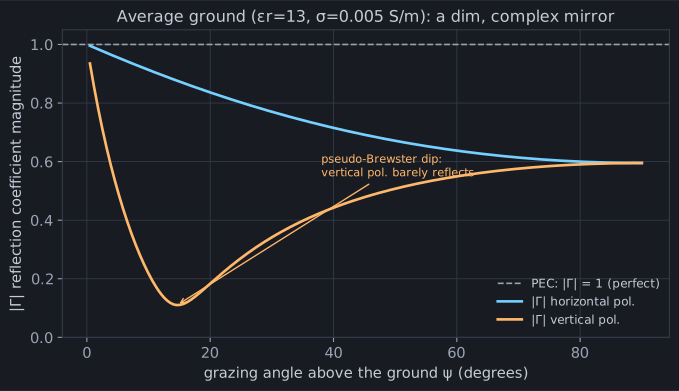
Nothing about this is 1. Horizontally polarized waves reflect fairly well at
low angles and fade toward 0.6 overhead. Vertically polarized waves do something
dramatic — near the pseudo-Brewster angle (~15° here) the ground barely
reflects them at all, |Γ| diving toward 0.1. That single dip is why vertical
antennas over real ground behave so differently from the textbook-perfect case.
And here’s the bargain: putting this into the solver costs almost nothing beyond
chapter 8. It’s the same image, with its contribution multiplied by Γ
before it’s added to each matrix entry — one complex, angle-dependent weight per
interaction, no new unknowns
(_ground_refl.py;
NEC calls this ground mode “GN 0”). In momwire it’s one more argument,
ground_eps=(13, 0.005).
Good until it isn’t
Section titled “Good until it isn’t”So how good is a weighted mirror? Put it up against the exact answer — the full Sommerfeld solve of chapter 10 — across height:
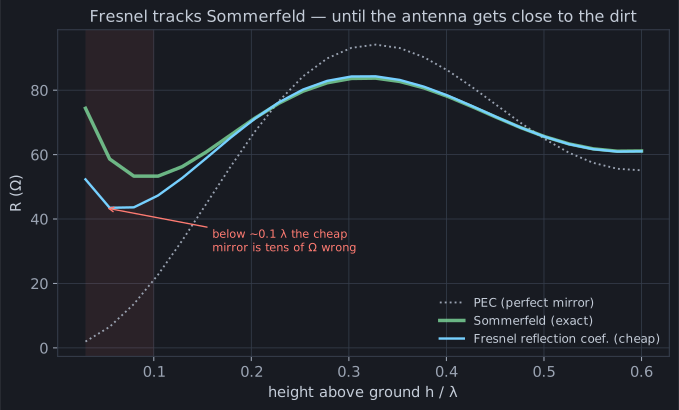
Two things to take away. First, the good news: from about 0.15 λ upward the cheap model is indistinguishable from the exact one — a fraction of an ohm apart, for a fraction of the cost. For the vast majority of real antennas, a half-wave or more off the ground, the Fresnel reflection coefficient simply is the right answer.
Second, the honest news: below about 0.1 λ it falls apart, tens of ohms
adrift. The reflection-coefficient picture assumes the antenna’s field arrives
at the ground as a plane wave reflecting at a definite angle. When the wire is
a stone’s throw from the dirt, that assumption fails — the near field is not a
plane wave, and no single Γ(angle) can describe it. Notice, though, that even
where it’s wrong, it’s wrong in the right direction: unlike the PEC image,
which shorts a low horizontal dipole to nearly zero, real lossy ground keeps R
up in the 60–75 Ω range — a low dipole over dirt still radiates. Fresnel gets
that qualitative rescue, just not the exact number.
Run it yourself
Section titled “Run it yourself”import numpy as npfrom momwire import BSplineSolver
# horizontal dipole, 0.2 lambda up, over average groundwire = np.array([[-5.291, 0.0, 0.2 * 22.0], [5.291, 0.0, 0.2 * 22.0]])solver = BSplineSolver(wires=[wire], nsegs=21, wavelength=22.0, wire_radius=0.0005, degree=2, ground_z=0.0, ground_eps=(13.0, 0.005), # <- real dirt feed_wire_index=0, feed_arclength=5.291)Z, _ = solver.compute_impedance()print(f"Z_in = {Z.real:.0f} {Z.imag:+.0f}j ohms") # ~70 +3j — vs 66 +18j over PECFor the low-antenna case — a receiving loop on the grass, a Beverage, an NVIS dipole a tenth of a wavelength up — the cheap mirror isn’t good enough, and there is no shortcut. Chapter 10 pays Sommerfeld’s full price, and tells the story of making that price affordable.